On our last trip to the Kruger National Park in South Africa we were about to give up on the illusive leopard when the call came over the two-way radio, Rangers use these to keep each other updated on sightings. Ingwe at Zebra Crossing!!!
Our lion sighting is cut short, magnificent as it is, we need to make our way to the site where the illusive Ingwe (leopard) is. The sun is setting on the African bush and the air is getting cooler as the last few rays start to disappear behind the Drakenberg Mountains in the background. It feels like we are moving at the speed of light as the open Jeeps we use doesn’t give much protection against the elements. In actual fact we might be doing a maximum speed of 45 km an hour. Even less as the dirt and dust roads are not that easy to navigate.
This is as exciting as it gets, because this is the one that no one guarantees you will see. As we get closer, we see that we need to go off road, this is not something done, except when we are in search of Big Cats. The sun has set and we see other Jeep lights in the thick bushes, how we will get there, I have no idea, but the Tracker and the Ranger will find a way. What will we see when we get there. As we navigate through the bushes, you must duck and dive to miss the Knob Thorn trees, that is everywhere in the Kruger. The vegetation is thick, the grasses long and the flooding in January hasn’t helped as there are large areas with severe erosion, so believe me when I say we are doing a proper 4×4 experience through the thickets. Sliding around in our seats as we try to make our way closer to get a glimpse of the silent shadow in Kruger.
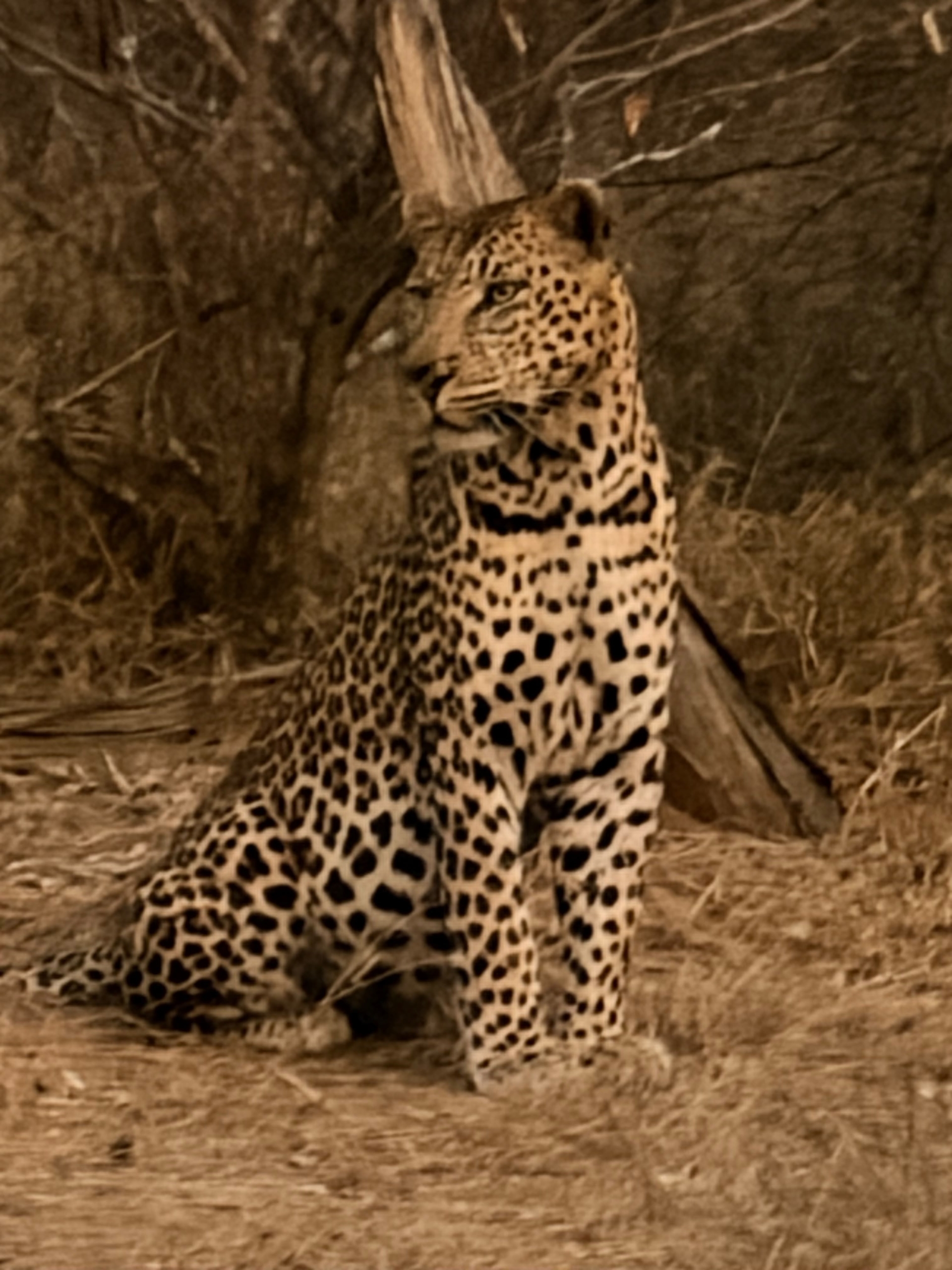
There he is, the most beautiful beast I have seen, this leopard is enormous, I guess he weighs about 95kg. Sitting silently as 2 vehicles maneuver so we can get a better view. He doesn’t flinch for the search lights, he knows he is the man of the moment. He turns his head and looks at the vehicle not bothered by our presence in his natural habitat. I sit in awe of this animal; he has a strength and presence I can’t explain. Without him knowing he is the perfect model for our photos. He gets up slowly; stretches his body and decides he has had enough of us. He disappears into the bushes as quickly as he appears. The 5 minutes he graced us with his presence felt like an hour. Now to get our bums back on a gravel road, we missed our sundowners time, but who cares as were just blessed to see the Silent Shadow in the bush, the one animal most people don’t get to see when they take an African Safari.
The rosette markings on their coats feature circular spot patterns without inner spots, unlike jaguars. These break up their outline for camouflage in dappled sunlight and dense foliage. Black panthers are melanistic leopards, possessing identical rosette patterns visible under close light. Their arboreal strength lets these animals have extremely powerful shoulder muscles allow leopards to hoist prey weighing more than themselves high into tree branches, safely keeping meals away from scavengers like hyenas and lions. They are solitary predators that ambush their prey, they’re highly nocturnal and territorial, leopards rely on stealth to stalk within 5 meters of prey before launching an explosive pounce. Their diet ranges from small rodents and birds to medium-sized ungulates like Impalas and deer. Auditory and visual sense is important. Their large retinas give them night vision six times sharper than a human’s, paired with sensitive whiskers to navigate dense brushes in pitch darkness.
Conservation of these animals is extremely important; the IUCN recognizes eight distinct subspecies across Africa and Asia. While African leopards retain larger strongholds, Asian subspecies face severe habitat fragmentation. Amur Leopard, the rarest big cat on Earth, with roughly 100 individuals remaining in the Russian Far East and Northern China is the most endangered. Snow Leopard & Clouded Leopard, despite sharing the name, snow leopards (Panthera uncia) and clouded leopards (Neofelis nebulosa) are distinct species separate from Panthera pardus. Major threats include habitat loss, human-wildlife conflict over livestock, and illegal poaching for skin and body parts. While leopards and jaguars look strikingly similar at first glance, they inhabit entirely different continents and possess distinct physical adaptations tailored to their environments.
The leopard, the smallest of the four big cats in the Genus Panthera (alongside lions, tigers, and jaguars), is famed for its unmatched adaptability, stealth, and tree-climbing ability. Males can weigh 37–90 kg (82–198 lbs) and females 28–60 kg (62–132 lbs). Speeds of up 58 km/h (36 mph), they can outrun almost any prey. If they are lucky, they can reach 12–17 years in the wild and up to 23 years in captivity. In Sub-Saharan Africa, Middle East, Central Asia, India, Southeast Asia you will find different sub species, according to the IUCN Status they are classified as Vulnerable (population declining overall)
We ended the day with drinks, reflecting on our safari. The sightings were spectacular and the best was kept for last; I will always remember how the bush fell silent again, the track in the sand was blowing away and the ghost of the valley left us changed forever.
Because Africa isn’t just a destination, it’s an experience…